How Much Do Clippers Actually Make? The 2026 Numbers, Including the Ones Nobody Posts
Campaigns advertise $1–5 per 1,000 views. Independent tracking of $2.58M in payouts says the blended rate actually paid is about $0.39, and average lifetime earnings per clipper are roughly $305. Here's the real math — rate tiers, what kills payouts, and the break-even that decides whether clipping pays you.

The clipping economy is real money. Independent tracking of public campaign data counts $2.58 million paid out to 8,466 unique earners across 6.6 billion views, with roughly $887,000 paid in February 2026 alone. People genuinely earn from cutting other people's streams into shorts.
The same dataset contains the number nobody screenshots: average lifetime earnings per clipper work out to about $305, and the blended rate actually paid across all tracked views is roughly $0.39 per 1,000 — well below the $1–5 that campaigns advertise.
Both things are true at once. This post is the honest arithmetic between them: what the rate tiers really are, what silently eats your payout, what different tiers of clipper actually take home, and the one calculation that decides whether the work pays you or you pay it.
What do clipping campaigns advertise?
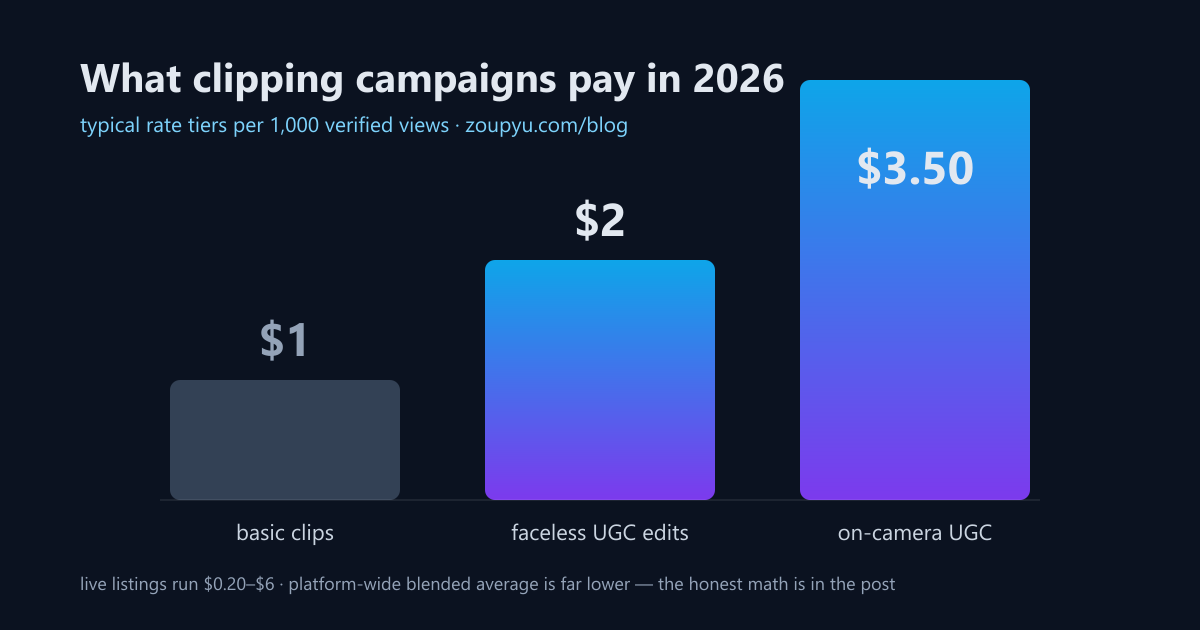
A clipping campaign is simple: a streamer, musician, or brand funds a pool. Clippers post approved clips. You get paid per 1,000 verified views until the pool empties or you hit a cap. Current rate tiers:
| Clip type | Rate per 1,000 views |
|---|---|
| Basic clips, minimal editing | ~$1 |
| Faceless UGC-style edits | ~$2 |
| On-camera UGC | ~$3.50 |
| Crypto and finance niches (highest-paying, most competitive) | $3–$6 |
| Full range across live listings | $0.20–$6 |
The platform-wide average sits near $1.25 per 1,000 views. Campaigns at $5 exist and fill fast.
What actually gets paid?
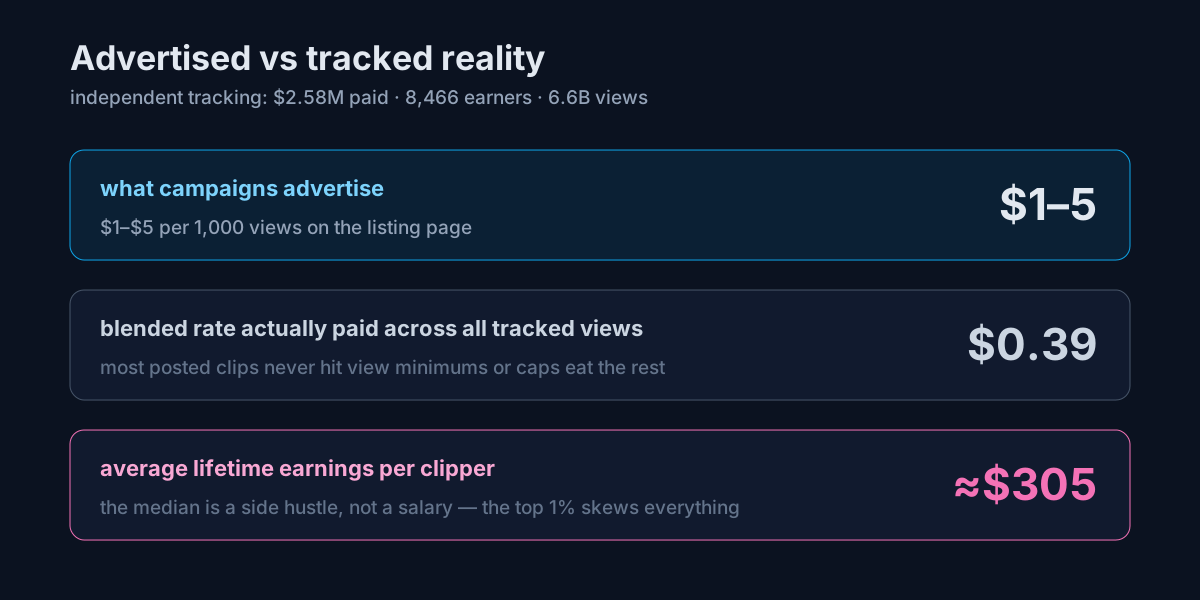
The gap between $1.25 advertised and $0.39 blended isn't fraud — it's structure. Four things eat the difference:
- Per-clip and per-account caps. Campaigns cap payouts to keep budgets sane. Your one clip that hit 2 million views may have been capped at the equivalent of 200,000.
- View minimums. Many campaigns don't pay on clips below a threshold. A clip at 600 views frequently pays exactly zero, and most clips are small clips.
- Verified views, not platform views. The counter that pays you is stricter than the one on your screen.
- Pools run dry. Post into a campaign late in its cycle and the budget may be gone before your views land.
The distribution is brutally top-heavy: a handful of clippers with multi-account systems on high-CPM campaigns pull five figures monthly, and their earnings dominate the total while thousands of participants sit near the $305 lifetime average.
What do real clippers take home?
Aggregating the earnings bands reported across 2026 guides and platform data:
| Clipper tier | Monthly earnings |
|---|---|
| Beginners | $100–$500 |
| Consistent clippers, 5–15 clips daily across campaigns | $500–$2,000 (one source: $1–3k) |
| Serious operators, 10–20 posts a day on chosen campaigns | $400–$1,500; top faceless operators $3,000–$8,000 |
| The top 1%, multi-account systems on high-CPM campaigns | $5,000–$10,000+, typically after 6+ months |
Notice the pattern in every band: the variable that separates them is volume. Not editing skill, not taste — volume of posted clips across enough campaigns for the top-heavy distribution to eventually pay off. Which puts the real constraint in an awkward place.
Is time per clip the real bottleneck?
If earnings scale with volume, then your hourly rate is decided by how long one clip takes. Run the math on the manual workflow: watch a 3-hour VOD to find moments (2–3 hours), cut and reframe each clip to 9:16, add captions, export (15–30 minutes each). Eight clips from one VOD lands somewhere around 4–6 hours of work.
At the $1.25 platform average, those eight clips need about 32,000 views combined just to make that session worth $40 — before you've priced your own time at anything sane. This is why most people quit clipping in month one. Not because the rates are bad, but because the throughput is.
What is the break-even calculation?
So the question isn't "what do campaigns pay" — it's "what does one clip cost me, in time and tooling, and how many views does it take to clear that."
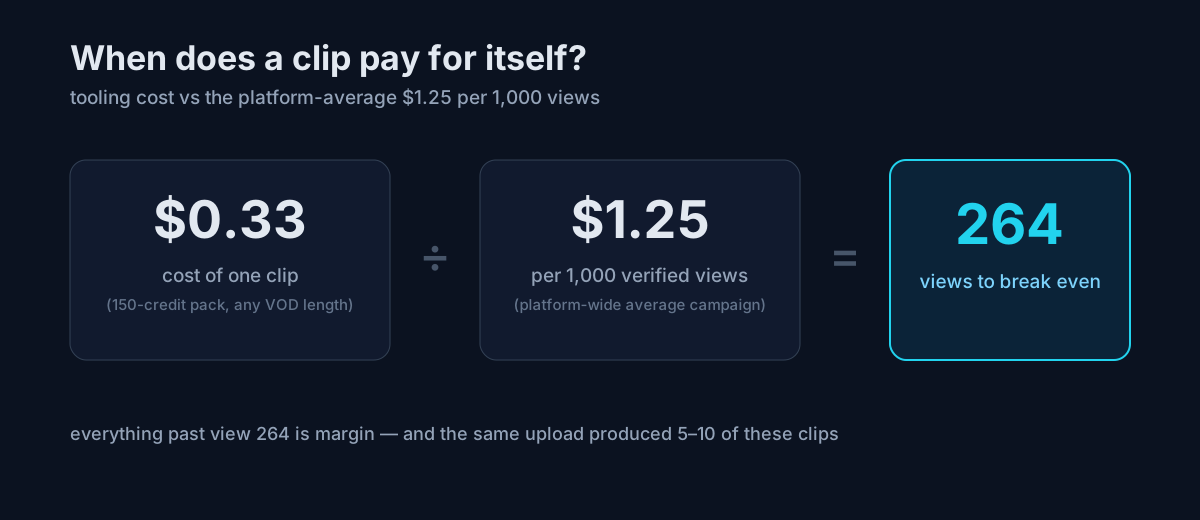
On tooling cost, the market splits sharply. Subscription clip tools charge $9.99–$29/month, and the per-minute ones price by source length — which is punishing when a clipper's raw material is 3-hour VODs. One gaming-specific tool charges $29/month for 5 hours of footage: less than two long VODs.
Zoupyu meters the stretch you pick rather than the file you upload. An 80-credit pack works out to $0.61 per credit, and one credit clips an hour — so mining the best hour of a stream costs $0.61, and taking a full three hours costs $1.84. Either way one run returns 5–10 clips. At the $1.25 platform average, that clip breaks even at 490 views — 1,470 if you took the full three hours — and the other clips from the same run are already paid for.
That's the whole economic argument, and it's why the billing unit matters more to clippers than to any other user: you are the person feeding the longest possible sources into the machine, over and over, and most of what you feed it is footage you were never going to post.
How do you actually make clipping work?
- Pick campaigns by expected value, not headline rate. A $5 CPM campaign with 400 clippers fighting over a small pool can pay less than a $1.50 campaign nobody found. Check pool size, caps, and how full the campaign already is.
- Read the minimums before you post. A campaign with a 1,000-view minimum quietly zeroes most of your output.
- Optimize for volume, then quality. The distribution rewards shots on goal. Getting from 3 clips a day to 15 matters more than making any single clip 20% better.
- Clip long VODs — but check what your tool meters. Three-hour streams hold the most clippable moments and the least competition, precisely because they're expensive to process with per-minute pricing. A per-minute tool bills all 180 minutes whether or not you use them; a tool that bills the stretch you select charges you for the part you actually mine. That difference is your margin.
- Track cost per clip like a business. Tool cost plus your time, divided by clips produced. If a clip costs $2 all-in and campaigns pay $1.25 per 1,000 views, you need 1,600 views per clip just to break even — a very different game from 490.
- Don't quit on one campaign. Top-heavy distributions mean most clips underperform and a few carry the month. That's the shape of the business, not a sign you're bad at it.
The honest summary
Clipping in 2026 is a real income stream with an unglamorous shape: a few thousand dollars a month is achievable with serious volume and campaign selection; a few hundred is the realistic median; and the advertised CPM is the ceiling, not the expectation. The people who make it work treat it as a throughput business — and the cost of one clip is the number that decides everything.
If you want to test the throughput side: paste a Twitch VOD link and Zoupyu returns 5–10 vertical clips with captions burned in, AI-scored for viral potential so you know which ones to post first. An hour of whichever stretch you pick, per credit. No subscription. The Facecam Layout keeps the streamer's facecam — here's how the detection works — which matters when the reaction is the clip.
Frequently Asked Questions
Advertised rates run $1–5 per 1,000 verified views, with tiers around $1 for basic clips, $2 for faceless UGC edits, and $3.50 for on-camera UGC. Crypto and finance campaigns reach $3–6. The platform-wide average is near $1.25, but independent tracking of $2.58M in payouts shows the blended rate actually paid is about $0.39 per 1,000 — caps, view minimums, and exhausted pools account for the gap.
It can be, but the median is modest: average lifetime earnings per clipper are roughly $305 across tracked data. Beginners typically earn $100–500/month, consistent clippers $500–2,000, and the top 1% running multi-account systems clear $5,000–10,000+. Earnings scale with posted volume, so profitability depends mostly on how fast and cheaply you can produce clips.
It depends entirely on your cost per clip. At the platform-average $1.25 per 1,000 views, a clip costing $0.61 in tooling breaks even at 490 views. A clip costing $2 all-in needs 1,600 views. This single ratio — cost per clip divided by campaign CPM — decides whether clipping pays you or you pay it.
Because clippers work with the longest source material in the market. Per-minute pricing charges by source video length, so a 3-hour Twitch VOD consumes an enormous share of a monthly quota — one gaming tool allows just 5 hours of footage for $29/month, under two long VODs. Per-video pricing charges the same for an 8-minute clip source and a 3-hour stream.
Volume, then campaign selection. The payout distribution is top-heavy — most clips underperform and a few carry the month — so more shots on goal beats polishing any single clip. Going from 3 to 15 posted clips daily changes earnings more than a 20% quality improvement. That makes time-per-clip the real constraint, which is why automation of the find-cut-caption-reframe loop matters more than editing skill.
Vedansh Chauhan
Vedansh is the founder of Zoupyu, a tool that turns long videos into viral Shorts. He writes about YouTube growth, the creator economy, and what actually works on the algorithm.
Turn your long videos into viral Shorts
Upload once, get 5–10 ready-to-post clips with Hinglish subtitles in minutes.