What Makes a Clip Go Viral? What 192 AI-Scored Clips Told Us
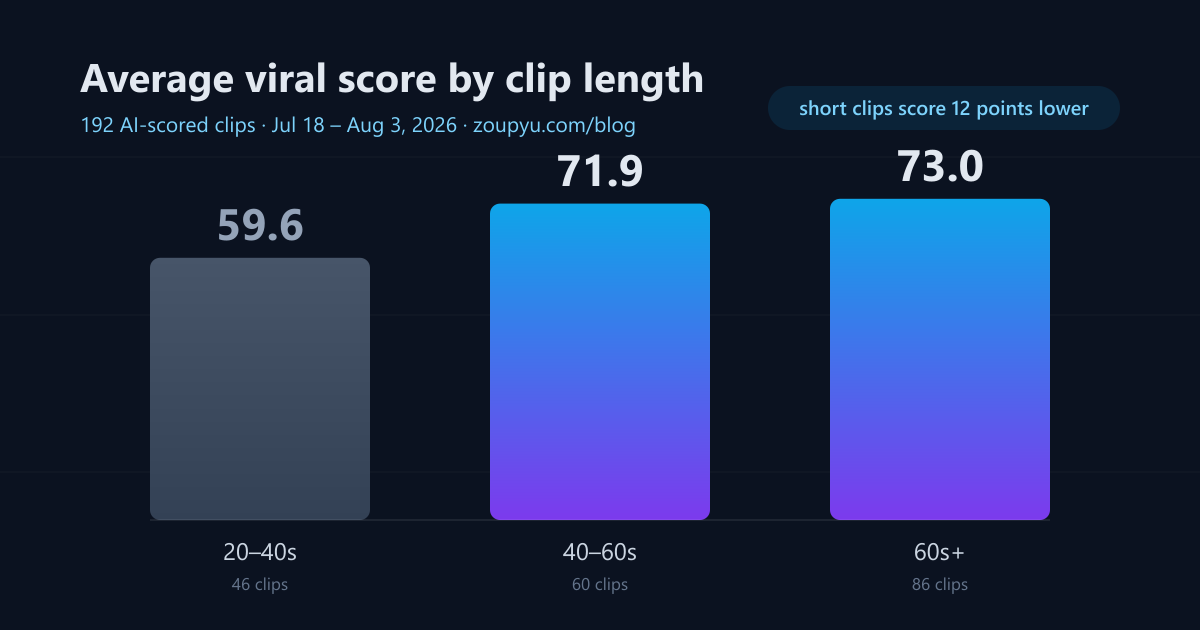
We aggregated every clip our viralometer scored in its first 17 days of production — 192 clips cut from real creator uploads. The data breaks some folk wisdom: 40–75 second moments outscored 20–40 second ones by 12 points, and the best moment of a video is equally likely to be at minute 3 or minute 33.

Every clip Zoupyu renders gets a viral score from 0–99 — an AI judge grades the moment on three things before you ever see it. That means our database quietly accumulates something nobody else has: rubric-scored data on where strong moments actually live inside real creator videos.
This post is the first look at that data. We aggregated every scored clip from the viralometer's first 17 days in production — 192 clips, July 18 to August 3, 2026 — cut from real uploads: Hinglish podcasts, stand-up sets, gaming sessions, commentary videos. No cherry-picking; this is the full production dataset, anonymized to pure numbers.
Four findings stood out, and two of them contradict advice you've probably been given:
- Short clips score worse. Moments cut to 40–75 seconds outscored 20–40 second moments by 12+ points on average.
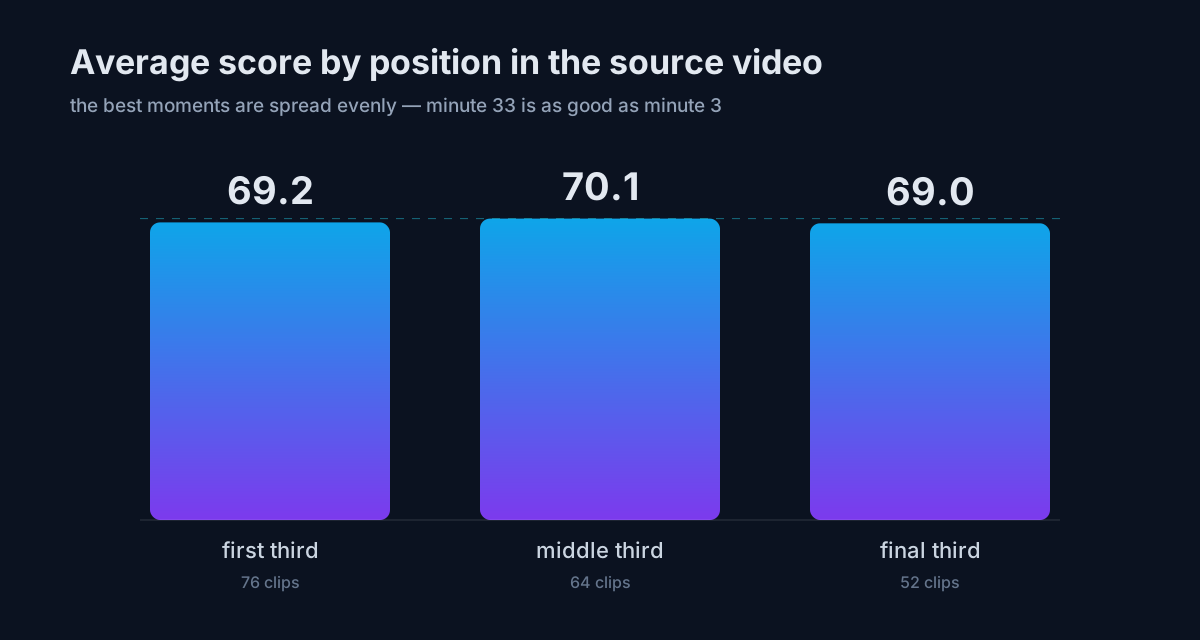
- Great moments are uniformly distributed. The first, middle, and final thirds of source videos produced near-identical average scores — 69.2, 70.1, and 69.0.
- A scroll-stopping hook doesn't guarantee a good clip. Hook strength and story arc agree with each other far less (r = 0.75) than either agrees with the final score.
- Audience replay data is worth about 6 points. Clips picked where YouTube's replay heatmap flagged a peak averaged 74.3 versus 68.0 without that signal.
Here's each one in detail — plus the honest limitations of a 192-clip dataset.
What does the viral score actually measure?
Full transparency, because a number you can't inspect is a number you shouldn't trust. The viralometer grades every candidate moment on three sub-scores, each 0–100:
- Hook — would the first ~3 seconds stop a scroll?
- Arc — does the clip open a loop and close it before it ends? Setup, escalation, payoff — inside the clip.
- Value — how much information delta or emotional intensity does the viewer walk away with?
The composite is a weighted blend — hook counts 40%, arc 30%, value 30% — plus a small capped bonus when the audio track contains a measurable crowd reaction (laughter, applause) inside the clip window. The judge reads the transcript cut into complete conversational beats; it never sees view counts, titles, or thumbnails. So to be precise about what this data is: it measures moment quality against a virality rubric, not TikTok outcomes. We'll connect scores to platform performance when we have enough posted-clip data to do it honestly.
Finding 1: Is the 30-second clip a myth?
The most repeated advice in short-form — "keep it under 30 seconds" — does not survive contact with this data. Average viral score by clip length:
| Clip length | Average score | Clips measured |
|---|---|---|
| 20–40 seconds | 59.6 | 46 |
| 40–60 seconds | 71.9 | 60 |
| 60+ seconds | 73.0 | 86 |
That's a 12–13 point cliff between short clips and everything longer, and the mechanism is visible right in the sub-scores: short clips can hook (avg hook 63.3) but they can't complete an arc. A moment needs room to set something up, escalate it, and pay it off. Cut at 25 seconds, you usually keep the setup and amputate the payoff — and the arc score collapses.
One more detail worth noticing: not a single production clip came out under 20 seconds. That's by design — our cutter selects complete conversational beats rather than slicing at fixed durations, and a complete beat with a setup and a payoff essentially never fits in 19 seconds. If your workflow involves hard-trimming everything to 15 seconds "for retention," this data suggests you're trimming away the exact thing that makes moments land.
Finding 2: Does it matter where in the video a clip comes from?
Where do the best moments of a video live? Split every source video into thirds and average the scores of clips found in each:
| Position in source | Average score | Clips measured |
|---|---|---|
| First third | 69.2 | 76 |
| Middle third | 70.1 | 64 |
| Final third | 69.0 | 52 |
Statistically flat. The strongest moment of a 90-minute podcast is as likely to be buried at minute 63 as served up in the opening 10.
This matters because humans don't scrub timelines uniformly. When you review your own footage, you check the beginning, you check the bits you remember being good, and you get tired. The middle-to-late stretch of long videos is systematically under-harvested — by creators, not by the content. It's also, frankly, the argument for machine-scanning full videos instead of eyeballing them: the AI is not more creative than you; it is just incapable of getting bored at minute 55.
Finding 3: Do hooks lie?
Hook carries the biggest weight in the composite (40%), and yet it has the weakest relationship with the final score of the three sub-scores — correlation 0.89, versus 0.95 for both arc and value. More telling: hook and arc only correlate 0.75 with each other — the lowest agreement between any two sub-scores in the dataset.
Translated out of statistics: clips that stop the scroll but don't pay it off are a real, measurable category. The inverse exists too — moments with complete, satisfying arcs behind unremarkable first seconds. If you're grading your own clips by "does the opening grab me," you're using the noisiest of the three signals. The arc is the better predictor of the final grade — which matches what anyone who has watched a promising clip fizzle at second 20 already suspects. We wrote about the anatomy of this in what makes a moment feel viral; the data now puts numbers on it.
Finding 4: How much is audience data worth?
When a source video comes from YouTube with replay-heatmap data — the little bump graph showing where viewers rewatch — our picker uses those peaks as one input. Clips associated with a measured replay peak averaged 74.3 (43 clips); clips picked without any audience signal averaged 68.0 (149 clips).
Six points is a meaningful gap in a distribution where the top 10% starts at 83. It's also intuitively right: a replay peak is hundreds of strangers independently agreeing "this part." When that signal exists, the AI's shortlist starts from evidence instead of inference. It's why we treat audience data as a first-class input rather than a gimmick — and why silent uploads lean harder on audio-energy and vision analysis to compensate.
This also has a direct commercial edge for anyone clipping for campaign payouts: scores let you decide posting order before you spend views finding out. The clipping-economy math turns on exactly that kind of throughput decision.
Is the grading curve honest?
Distribution facts, because a score means nothing without its curve:
- Median clip: 75
- A quarter of clips score 63 or below
- Top 10% threshold: 83
- Highest score ever given in production: 89
- Clips scoring 90–99: zero
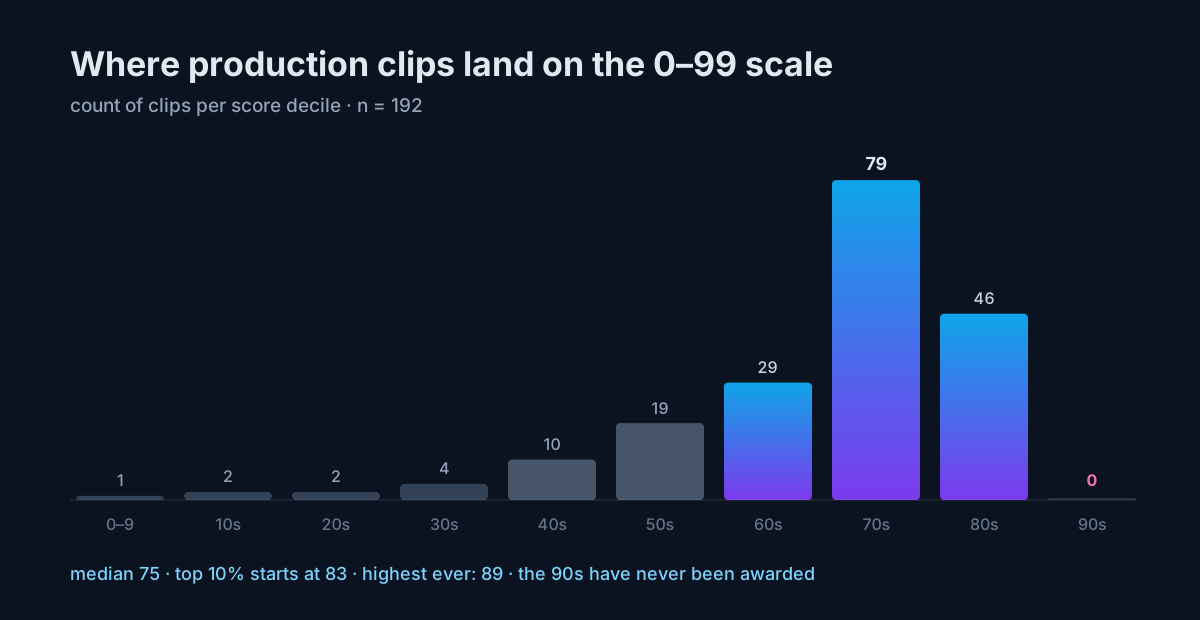
About 65% of production clips land in the 70–89 band — expected, since the judge only cuts moments it already believes in; the left tail is mostly low-signal footage (long silent stretches, wall-of-noise audio) where every candidate was weak. But the empty 90s bracket is the part we like: the top of the scale is reserved for something better than anything the judge has seen yet. A tool that hands out 95s like participation medals would be easier to market and useless to trust.
Methodology and honest limitations
- Dataset: all 192 clips scored and successfully rendered between July 18 and August 3, 2026 — the viralometer's entire production history at time of writing. No sampling, no exclusions beyond failed renders.
- Source material: real user uploads to Zoupyu — predominantly Hinglish and English podcasts, comedy, commentary, and gaming sessions.
- What the score is: an AI judge's grade against a hook/arc/value rubric, computed identically for every clip. What it is not: a measurement of views. Treat these findings as "what a consistent rubric rewards in real footage," not "guaranteed TikTok physics."
- Sample size: 192 is enough to see 12-point gaps; it is not enough for fine-grained claims, so we've kept sub-group findings to the buckets with real counts. We'll re-run this analysis at 1,000 scored clips and update — same URL, same methodology, bigger N.
What should you do with this?
- Stop hard-capping clips at 30 seconds. Let the moment's arc decide the length. Our data says 40–75 seconds is where complete moments live.
- Mine your full videos, especially the middle. Your minute-40 lull is statistically as rich as your opening. If you can't face re-watching, that's the part to automate.
- Don't judge clips by their first 3 seconds alone. Ask whether the loop closes. A hook without a payoff is a swipe-away at second 15.
- Keep your audience data attached. If your source lives on YouTube, replay peaks are free evidence about what strangers rewatch.
Every clip Zoupyu produces shows its viral score with the hook/arc/value breakdown on the clip card — free on every plan, including the Facecam Layout (which keeps the streamer's facecam) and Twitch VOD workflows. Upload something and see where your moments actually land on the curve.
Frequently Asked Questions
In production data (192 clips, Jul 18–Aug 3, 2026), the median clip scores 75 and the top 10% starts at 83. Anything at 80+ is genuinely strong. The highest score ever given is 89 — the 90s bracket is intentionally hard to reach, so treat 85+ as exceptional rather than expecting 95s.
No — the opposite, in our data. Clips of 20–40 seconds averaged 59.6 while clips of 40–60 seconds averaged 71.9 and 60+ seconds averaged 73.0. The mechanism is the story arc: very short cuts keep the hook but amputate the payoff. Length should follow the moment, not a fixed cap.
Evenly throughout. Splitting source videos into thirds, average clip scores were 69.2 (early), 70.1 (middle), and 69.0 (late) — statistically flat. The middle and late sections of long videos are under-harvested because humans scrub timelines unevenly, not because the moments aren't there.
An AI judge reads the transcript cut into complete conversational beats and grades each candidate moment 0–100 on hook (would the first ~3s stop a scroll), arc (does it open and close a loop inside the clip), and value (information or emotional payoff). The composite weights hook 40%, arc 30%, value 30%, plus a small capped bonus for measurable crowd reactions in the audio. It never sees view counts — it measures the moment, not the upload.
Not yet — and we say so explicitly. These are rubric scores from a consistent AI judge across real creator footage, which makes them comparable to each other but not a guarantee of platform outcomes. We'll publish score-versus-performance data once enough posted clips accumulate to analyze honestly.
Vedansh Chauhan
Vedansh is the founder of Zoupyu, a tool that turns long videos into viral Shorts. He writes about YouTube growth, the creator economy, and what actually works on the algorithm.
Turn your long videos into viral Shorts
Upload once, get 5–10 ready-to-post clips with Hinglish subtitles in minutes.